| Motherboard Categories |
|
|
| Sponsor |
|
|
| Links |
|
|
|
| July 31, 2007 |
| Gigabyte’s RD790 Motherboard |
|
The upcoming RD790 motherboard from Gigabyte is GA-M790-DQ6. But, causes it is not production yet, so some changes might still happen. The disappointing change is, Gigabyte had decided to remove FireWire 800 support from this AMD motherboard. On the rear panel, Gigabyte also removes the parallel port and it is replaced by two mounted eSATA ports. But, If you still need this parallel port, don't worry, Gigabyte still has added an internal connector for it and supplies one with a long cable in the box with the motherboard.
The heatpipe cooling system has been changed to be a better version with two instead of one heatpipes and some other modifications. Not only that, Gigabyte puts the power regulation on the motherboard all in a stright line which it easier to produce an efficient cooling solution. Finally, the GA-M790-DQ6 features AMD RD790 chipset and it supports HyperTransport 3.0 and AM2+ CPU’s.
Info : Gigabyte
Labels: Gigabyte, News
|
|
|
| posted by admin |
|
|
|
|
| Foxconn 975X7AB-8EKRS2H |
|

Like many computer motherboard manufacturers, Foxconn is serious about keeping both AMD and Intel users as happy and content with any motherboard purchase. Recently, various Intel motherboard based 975 chipsets have finally been hitting the shelves. When the Core 2 Duo was released, the choices were very limited to a couple makers one of which was Asus and their P5B Motherboard. The 965 chipsets aren't much different than the 975 in stock features. What changes more so is the features motherboard manufacturers are putting on the two chipset based boards. Both the 965 and 975 are stated to support upcoming Core 2 Quadro. The 975 chipset based motherboard we have today is the Foxconn 975X7AB. The AB version of this board supports Conroe core processors and comes equipped with several improvements from the original AA version.
The specifications of this computer motherboard are :
|
Foxconn 975X7AB-8EKRS2H
|
|
Processor
|
Supports compatible Intel SocketT (LGA775) processors (Intel Core 2 Extreme, Core 2 Duo (Conroe), Pentium EE, Pentium D, Pentium 4 processors)
|
|
Chipset
|
- Northbridge : Intel 975X Express
- Southbridge : Intel ICH7R
|
|
Front Side Bus
|
1066 / 800 MHz
|
|
Memory
|
- 4 x 240-pin DIMM sockets, max 8GB
- Dual channel architecture, unbuffered, 1.8V DDR2 533 / 667 / 800 MHz with or without ECC
- DDR2 800 requires P15 or later BIOS and updated SPIload
|
|
Expansion Slots
|
- 2 x PCI Express x16 (function as 2 x8 under ATI CrossFire)
- 2 x PCI Express x1
- 2 x PCI
|
|
Storage
|
IDE :
- 1 x ATA-100 + 1 x ATA-133
Serial ATA (SATA) + RAID :
- 4 x SATA II/300, support RAID 0, 1, 0+1, 5, and JBOD
- Second SATA II/300 controller with 1 rear panel/external connector
|
|
LAN
|
- 2 x Gigabit Ethernet (10/100/1000) controllers, dual ports, PCIe (Marvell)
|
|
Audio
|
- 7.1 channel, high definition (Realtek)
|
|
IEEE 1394
|
2 x IEEE 1394a ports (one at midboard; one at back panel)
|
|
Back Panel I/O Ports
|
- 1 x PS/2 keyboard
- 1 x PS/2 mouse
- 2 x RJ45 (LAN)
- 4 x USB 2.0
- 1 x parallel (SPP/ECP/EPP)
- 1 x IEEE-1394a (6-pin)
- 2 x S/PDIF (1 x coax out + 1 x optical out)
- 1 x eSATA
- 7.1 channel audio (6 jacks)
|
|
Internal I/O Connectors
|
- 1 x floppy disk drive
- 2 x USB 2-port headers, ver. 2.0
- 1 x IEEE-1394a header
- Front audio header
|
|
BIOS
|
4Mb flash EEPROM with LAN boot, PnP, ACPI, WfM, DMI 2.0
|
|
Manageability
|
PCI 2.3, USB2.0; WfM 2.0, DMI 2.0
|
|
Support CD
|
- Drivers (chipset, RAID, audio, network, USB 2.0)
- Fox One
- Tiger One
- Foxconn LiveUpdate
- DirectX
- Adobe Acrobat Reader
- Norton Internet Security
|
|
Form Factor
|
ATX Form Factor, 30.5cm x 24.4cm
|
Visit the link to read more about this computer motherboard specs.
Labels: Foxconn, Intel
|
|
|
| posted by admin |
|
|
|
| July 30, 2007 |
| DFI nForce 680i LT-T2R |
|

Starting with their 680i LT motherboard, DFI has developed a completely new package for the computer motherboard and a real winner bundle. DFI nForce 680i LT-T2R comes in the new black - which is white - with green accents and lettering. On the front a little see through window offers a glance of the Southbridge cooler of the board. At the back of the board, the main of this computer motherboards specs are listed.
The less usual is DFI hasn't been installed the northbridge cooler on the motherboard yet. So, you must install it by yourself. The bundle for this Intel motherboard is very complete to say the least, everything you need is there, and more. Here's the list with the contents:
- Karajan Audio Module
- Motherboard Back Plate
- nVidia SLI connector
- UV Orange IDE cable
- UV Orange Floppy drive cable
- Four (4) UV Orange S-ATA cables
- Two (2) double S-ATA power connector adapters
- Three (3) Floppy disks with raid drivers (Vista/XP)
- CD-Rom with drivers and Software
- Quick start manual
- Full manual including (short) bios description
Here is the full specifications of this Intel motheboards :
|
DFI nForce 680i LT-T2R
|
|
Processor
|
- LGA 775 socket for Intel Core2 Quad, Intel Core2 Extreme, Intel Core2 Duo, Intel Pentium D or Intel Pentium 4
- Intel Enhanced Memory 64 Technology (EMT64T)
- Enhanced Intel SpeedStep Technology (EIST)
- Intel Hyper-Threading Technology
|
|
Chipset
|
- Northbridge : NVIDIA 680i LT SLI
- Southbridge : NVIDIA MCP55P
|
|
Front Side Bus
|
- 1333*/1066/800MHz FSB
*Available on CPUs that support 1333MHz FSB
|
|
Memory
|
- 4 x 240-pin DDR2 DIMM sockets
- DDR2 533, DDR2 667 and DDR2 800 DIMMs
- Dual channel (128-bit wide) memory interface
- Up to 8GB system memory
- Non-ECC x8 and x16 unbuffered DIMMs
- NVIDIA SLI-Ready Memory with EPP
|
|
Expansion Slots
|
3 x PCI Express x16 slots :
- SLI technology - 2 x16 slots both operate at full-bandwidth 16 lanes
- 3rd x16 slot for Physics card operates at x8 bandwidth
1 x PCI Express x4 slot
3 x PCI slots
|
|
BIOS
|
- Award BIOS
- CMOS Reloaded
- CPU/DRAM overclocking
- CPU/DRAM/Chipset overvoltage
- 8Mbit flash memory
|
|
Power Management
|
- ACPI and OS Directed Power Management
- ACPI STR (Suspend to RAM) function
- Wake-On-PS/2 Keyboard/Mouse
- Wake-On-LAN
- RTC timer to power-on the system
- AC power failure recovery
|
|
Audio
|
Karajan audio module
- Realtek ALC885 8-channel High Definition Audio CODEC
- 6 audio jacks
- 1 CD-in connector
- 1 front audio connector
DAC SNR/ADC SNR of 106dB/101dB
Full-rate lossless content protection technology
S/PDIF-in/out interface
|
|
Storage
|
IDE
- One IDE connector allows connecting up to two UltraDMA 133Mbps hard drives
Serial ATA with RAID
Six Serial ATA ports supported by NVIDIA MCP55P :
- SATA speed up to 3Gb/s
- RAID 0, RAID 1, RAID 0+1 and RAID 5
Two Serial ATA ports supported by Silicon Image SiI 3132 :
- SATA speed up to 3Gb/s
- RAID 0, RAID 1 and RAID 0+1
|
|
LAN
|
- NVIDIA MCP55P integrated with Gigabit MAC (Media Access Control) technology
- Two Vitesse VSC8601 Gigabit Phy chips
- Fully compliant to IEEE 802.3 (10BASE-T), 802.3u (100BASE-TX) and 802.3ab (1000BASE-T) standards
- NVIDIA DualNet technology
|
|
IEEE 1394
|
- VIA VT6307
- Supports two 100/200/400 Mb/sec ports
|
|
Back Panel I/O Ports
|
- 1 x PS/2 mouse port
- 1 x PS/2 keyboard port
- 2 x S/PDIF RCA jacks (S/PDIF-in and S/PDIF-out)
- Karajan audio module (6 audio jacks)
- 1 x IEEE 1394 port
- 2 x RJ45 LAN ports
- 6 x USB 2.0/1.1 ports
|
|
Internal I/O Connectors
|
- 2 x connectors for 4 additional external USB 2.0/1.1 ports
- 1 x connector for 1 external IEEE 1394 port
- 1 x connector for 1 external serial port
- 1 x connector for the Karajan audio module
- 1 x front audio connector (on the Karajan audio module)
- 1 x CD-in internal audio connector (on the Karajan audio module)
- 1 x S/PDIF connector for optical cable connection
- 1 x IrDA connector
- 1 x CIR connector
- 8 x Serial ATA connectors
- 1 x IDE connector
- 1 x floppy connector
- 1 x 24-pin ATX power connector
- 1 x 8-pin 12V power connector
- 2 x 4-pin 5V/12V power connectors (FDD type)
- 1 x front panel connector and 6 fan connectors
- 1 x diagnostic LED
- EZ touch switches (power switch and reset switch)
|
|
Form Factor
|
ATX Form Factor, 30.5cm x 24.4cm
|
More details about this motherboard specs, click on the link.
Labels: DFI, Intel
|
|
|
| posted by admin |
|
|
|
| July 28, 2007 |
| MSI P35 Platinum (Intel P35) |
|
.jpg)
MSI is one of the top tier computer motherboard manufacturers in the consumer PC industry, but there is no mistaking 2006 as the year that ASUS and Gigabyte took most of the limelight. Gigabyte's marketing machine pushed the whole solid capacitor design into high gear while ASUS flooded the market with specialized target focus computer motherboard models such as the TeleSky and Republic of Gamers. Both manufacturers also drew a lot of attention with an announced alliance (which didn't last), but most importantly, they made exciting computers motherboards that kept the market fresh. MSI on the other hand, was focusing more on their graphics card business.
With the launch of Intel's new Bearlake chipset family however, MSI has gone all serious about their next generation motherboards, they do have some interesting designs on hand.
Here is its computer motherboard specs :
|
MSI P35 Platinum (Intel P35)
|
|
Processor
|
- Supports all 90nm/65nm Intel LGA775 processors
- 45nm ready (Wolfdale & Yorkfield)
- Quad-Core Optimized
|
|
Chipset
|
Intel P35 / ICH9R
|
|
Front Side Bus
|
1333 / 1066 / 800 / 533 MHz
|
|
Memory
|
4 x DIMM, DDR2 1066 / 800 / 667 / 533 MHz, non-ECC, unbuffered memory
Dual channel memory architecture
|
|
Expansion Slots
|
2 x PCIe x16
2 x PCIe x1
2 x PCI
|
|
Storage
|
Intel ICH9R Southbridge :
- 6 x SATA 3.0Gbps interface
- Intel Matrix Storage Technology
- Supports RAID 0, RAID 1, RAID 0+1, RAID 5, RAID 10
Marvell 88SE6111 :
- 1 x Ultra ATA 33/66/100/133 (data transfer rate up to 133MB/sec.)
- 1 x SATA 3.0Gbps interface
|
|
LAN
|
Marvell 88E8111B Gigabit Ethernet PHY
|
|
Audio
|
- Intel High Definition Audio (Azalia)
- Realtek ALC888T HD Audio CODEC
- Optical S/PDIF
|
|
IEEE 1394
|
- VIA VT6308P FireWire controller
- 2 x 1394a ports @ 400 Mbps speed
|
|
Back Panel I/O Ports
|
2 x eSATA
6 x USB 2.0
1 x IEEE 1394a
1 x RJ-45 LAN
1 x Optical S/PDIF Output
1 x mini-DIN-6 PS/2 mouse port
1 x mini-DIN-6 PS/2 keyboard port
8-Channel Audio I/O ports
|
|
Internal I/O Connectors
|
1 x Floppy connector
1 x Ultra ATA IDE
5 x SATA
6 x USB 2.0
1 x IEEE 1394a
1 x COM port
|
|
Form Factor
|
ATX Form Factor, 30.5cm x 24.4cm
|
Visit the link to learn more about this computer motherboard specs.
Labels: Intel, MSI
|
|
|
| posted by admin |
|
|
|
|
| Biostar TA690G AM2 |
|
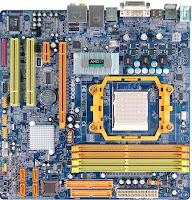
With Micro-ATX platform, Biostar TA690G AM2 motherboard will brings your computer become a home theatre for you. This computer motherboard stands out because of the comprehensive video outputs it has. A standard analog video output isn't too astounding, but a digital DVI port, S-Video TV-output and an HDMI video output all on one motherboard is pretty unique. The Biostar TA690G AM2 motherboard is built on AMD's 690G Northbridge and SB600 Southbridge chipsets, and it supports all Socket AM2 processors from the AMD Sempron to the Athlon64/X2 and FX processors. With AMD's 690G chipsets, it is include ATI Radeon X1250 engine on it. So, using Biostar TA690G AM2, you will gets a good solid computer platform for office applications and the like, without the need to install a stand alone video card on your computer. But if gaming is your thing, you still can install an add-on video card on its PCI Express x16 slot.
There are a couple of nice nods towards the user experience like a set of hard Power and Reset buttons on the motherboard's PCB, also fully passive thermal solution for each chipset is eye-catching. The large and higher heatsink attached to the northbridge to dissipate heat efficiently and the heatsink above the southbridge will cool down the temperature rapidly. This computer motherboard uses solid electrolytic capacitors, using conductive polymer materials, so it will extends the live-span of your motherboard.
Before you choose this motherboard for your computer, see specification bellow :
|
Biostar TA690G AM2
|
|
Processor
|
- AMD Socket AM2 (AMD Athlon 64 X2/64/FX/Sempron Processors)
- Hyper Transport Technology up to 2G
- Supports AMD Cool'nQuiet Technology
|
|
Chipset
|
AMD 690G / SB600
|
|
Memory
|
4 x DIMM, max. 8GB, DDR2 800 / 667 / 533 / 400 MHz, non-ECC, unbuffered memory
Dual channel memory architecture
|
|
Expansion Slots
|
2 x PCI-E x16
1 x PCI-E x1
1 x PCI
|
|
Integrated Video
|
ATI Radeon X1250 Graphics, On Board Graphic Max. Memory Share 512 MB
|
|
LAN
|
Realtek RTL8111B - Integrated 10/100/1000 Transceiver
|
|
Audio
|
Realtek ALC888 8+2-Channel HD Audio
|
|
Back Panel I/O Ports
|
1 x PS/2 Mouse
1 x PS/2 Keyboard
1 x HDMI
1 x DVI
1 x TV-OUT
1 x VGA
4 x USB 2.0
6 x Audio
1 x LAN (RJ-45)
|
|
Internal I/O Connectors
|
3 x USB 2.0 Headers
4 x SATA2 3Gb/s Connector
1 x Floppy Connector
1 x IDE Connector
1 x Front Audio Header
1 x CD-IN Header
1 x S/PDIF-OUT Header
1 x CPU FAN Header
1 x North Bridge FAN Header
2 x System FAN Header
1 x Printer Header
|
|
Accessories
|
1 x IDE Cable
1 x FDD Cable
1 x SATA Cable
1 x SATA Power Cable
1 x Real I/O Panel
1 x Fully Setup Driver
1 x User Manual
|
|
Form Factor
|
Micro-ATX Form Factor, 24.3cm x 24.4cm
|
Click on the link to learn more about this computer motherboard.
Labels: AMD, Biostar
|
|
|
| posted by admin |
|
|
|
| July 27, 2007 |
| The AGP Variation |
|
A number of non-standard variations of the AGP interface have been produced by manufacturers.
- 64 bit AGP
A 64-bit channel. Used in high end professional graphic cards. It was once proposed as an optional standard for AGP 3.0 in draft documents, but was dropped in the final version of the standard.
- AGP Express
Not a true AGP interface, but rather a way to allow an AGP card to be connected over the legacy PCI bus on a PCI Express motherboard. It is a technology found on ECS motherboards, and is used as a selling point for AGP card owners who want a new motherboard but do not want to be forced to buy a PCIe graphics card as well (most new motherboards do not provide AGP slots, only PCIe slots). An "AGP Express" slot is basically a PCI slot (with the electrical power of two) in the AGP form factor. While it offers backward compatibility with AGP cards, its disadvantages include incomplete support (some AGP cards do not work with AGP Express) and reduced performance - the card is forced to use the shared PCI bus at its lower bandwidth, rather than having exclusive use of the faster AGP.
- AGI
The ASRock Graphics Interface (AGI) is a proprietary variant of the Accelerated Graphics Port (AGP) standard. Its purpose is to provide AGP-support for those of Asrock's motherboards that use chipsets lacking native AGP-support. However, it's not fully compatible and several videocard chipsets are known to not be supported. The performance and the quality of that interface is somewhat questionable.
- AGX
The EpoX Advanced Graphics eXtended (AGX) is also a proprietary variant of the Accelerated Graphics Port (AGP) standard. It shares the same problems with the AGI port explained above. User manuals even recommend not using AGP 8X ATI cards with AGX slots.
- Ultra-AGP, Ultra-AGPII
It is an internal AGP interface standard used by SiS for the north bridge controllers with integrated graphics. The original version supports same bandwidth as AGP 8x, while Ultra-AGPII has maximum 3.2GB/s bandwidth.
- XGP
The Biostar Xtreme Graphics Port is also a variant of the Accelerated Graphics Port (AGP) standard. It is similar to the two standards above, in that it supports AGP cards with chipsets that do not support AGP. Also like the above, it has support issues with many AGP cards.
- AGR
The Advanced Graphics Riser is a variation of the AGP port used in some PCIe motherboards to offer a limited backwards compatibility with AGP. It is, effectively, a modified PCI slot with no direct interconnection with the CPU or memory, and thus slower even compared to an AGP 1x slot. Its actual compatibility with AGP cards is also limited, while motherboard manufacturers usually publish a specific compatibility list.
Source : Wikipedia
Labels: Knowledge
|
|
|
| posted by admin |
|
|
|
| July 26, 2007 |
| ASRock 4Core1333-Viiv |
|

4Core1333-Viiv is a computer motherboard from ASRock. ASRock uses P965 chipset for nortbridge and ICH8DH for southbridge. ASRock 4Core1333-Viiv compatible with all FSB1333/1066/800/533MHz CPUs and already support atI CrossFire technology, so you can makes your graphic card more powerfull. ASRock can locks PCIe and PCI buses clock, so don't worry about your add-on card while overclocking your motherboard. Not only that, for overclocking purpose, ASRock 4Core1333-Viiv was featured by Hybrid Booster to makes your components more safety.
Here is the specification of this computer motherboard :
|
ASRock 4Core1333-Viiv
|
|
Processor
|
- LGA 775 for Intel Core 2 Quad / Core 2 Extreme / Core 2 Duo / Pentium XE / Pentium D / Pentium Dual Core / Pentium 4 / Celeron / Celeron D, supporting Quad Core Kentsfield processors
- Intel Viiv Ready
- Supports Hyper-Threading Technology
- Supports Untied Overclocking Technology
- Supports EM64T CPU
|
|
Chipset
|
Intel P965 + ICH8DH
|
|
Front Side Bus
|
- Compatible with all FSB 1333(only in overclocking mode) / 1066 / 800 / 533 MHz
|
|
Memory
|
- 4 x DIMM, max. 8GB, DDR2 800 / 667 / 533 MHz, non-ECC, unbuffered memory
- Dual channel memory architecture
Due to the operating system limitation, the actual memory size may be less than 4GB for the reservation for system usage under Windows XP and Windows Vista. For Windows XP 64-bit and Windows Vista 64-bit with 64-bit CPU, there is no such limitation.
|
|
Expansion Slots
|
- 1 x PCI Express x16 slot
- 1 x AGI Express slot (PCI Express x4)
- 1 x PCI Express x1 slot
- 3 x PCI slots
|
|
LAN
|
- Gigabit LAN 10/100/1000 Mb/s
- Giga PHY Intel 82566DC
- Supports Wake-On-LAN
|
|
Audio
|
- 7.1 CH Windows Vista Premium Level HD Audio (ALC888 Audio Codec)
|
|
Connector
|
- 6 x SATAII 3.0 Gb/s connectors, support RAID (RAID 0, RAID 1, RAID 10, RAID 5 and Intel Matrix Storage), NCQ, AHCI and "Hot Plug" functions
- 1 x eSATAII 3.0 Gb/s connector (shared with 1 SATAII port), supports NCQ, AHCI and "Hot Plug" functions
- 1 x ATA133 IDE connector (supports 2 x IDE devices)
- 1 x Floppy connector
- 1 x DeskExpress Hot Plug Detection header
- 1 x Game port header
- 1 x HDMI_SPDIF header
- 1 x IEEE 1394 header
- CPU/Chassis FAN connector
- 20 pin ATX power connector
- 4 pin 12V power connector
- SLI/XFire power connector
- CD in header
- Front panel audio connector
- 3 x USB 2.0 headers (support 6 USB 2.0 ports)
|
|
Rear Panel I/O
|
ASRock 1394_eSATAII I/O Plus
- 1 x PS/2 Mouse Port
- 1 x PS/2 Keyboard Port
- 1 x Serial Port: COM1
- 1 x Parallel Port (ECP/EPP Support)
- 4 x Ready-to-Use USB 2.0 Ports
- 1 x eSATAII Port
- 1 x RJ-45 LAN Port
- 1 x IEEE 1394 Port
- HD Audio Jack: Side Speaker / Rear Speaker / Central / Bass / Line in / Front Speaker / Microphone
|
|
Form Factor
|
ATX Form Factor, 30.5cm x 22.9cm
|
Labels: ASRock, Intel
|
|
|
| posted by admin |
|
|
|
|
| DFI Launches LANParty UT P35 Motherboard |
|
DFI introduced yesterday the latest addition to its LANParty extreme motherboard line, the LANParty UT P35-T3R. The board adopts P35 + ICH9R chipsets as north and south bridge. Further, P35 supports DDR3 memory and Intel's next generation 45nm process CPUs. Known for innovation, DFI is also introducing with this motherboard, a whole new idea of external chipset cooling assembly.
The secret weapon: DFI unique heat pipe assembly
The designer of DFI LP UT P35 series has created a whole new "weapon", a heat pipe assembly from SB, NB then extend to PWM. The design of DFI's new heat pipe is totally different to others in market.
It uses a copper-made pipe to connect independent heat sinks of SB, NB and PWM together. Then, there will be an extension joint (Transpiper) to carry the heat out from the chassis. The Transpiper can be extended to where outside the PSU fan. That means the air flow from the PSU fan will be help to carry out the heat from Transpiper. Otherwise, the heat air flow will be stuck inside the chassis and that will jeopardize the stability of the system. This is a magnificent breakthrough of heat pipe assembly design.
Unique arrangement for Crossfire + Physics rendering
Since the Physics rendering technology has been revealed in PC market, gamers are all to pay close attention to it. Meanwhile, DFI was put it into LANParty motherboard as an advance features and that shows the gigantic power of Crossfire + Physics rendering. But 3 VGA cards bring a lot of heat as the same time. Hence, the arrangement of 3 VGA slots (2 CF + 1Physcis) seems especially essential for the system. If the spaces between 3 VGA slots are not enough, that'll cause heat dissipation problems. Therefore, DFI propose a perfect solution for that; the designer separated each of the slots with 2 additional PCI slot space. That means the 3 VGA slots located evenly in the board. That's a big improvement for efficient heat dissipation of VGA area between those "thick cards"(ex.1900, 2900).
Ultimate 8-phase Digital PWM
DFI is never satisfied to use any components of inferior quality. For this brand new model LP UT P35-T2R, DFI chooses to use an utmost 8 -phase Digital PWM in place of the advance 6-phase PWM. A digital PWM uses components to supply stabilized current, which accommodate enthusiasts ' needs in OC or Gaming. DFI UT P35 series provides sufficient current for the processor. Aside from this, the new heat dissipating fins of the PWM circuit further stabilize current flow to the system.
The cutting-edge audio solution- "Bernstein Audio"
Leonard Bernstein, best-known conductor and music composer of USA i n 50's of 20 century. Bernstein represents the supreme authority of classical music in Northern America. LP UT P35 series is equipped with this brand new "Bernstein Audio" module. In fact, the board's designer uses a new way to generate this module. For easier installation, designer moved this module close to "PCI slots area" for easy to mount in PCI bracket. Second, it obtains a perfect noise reduction than Karajan's. As all we know, no matter Pro-gamers or power users who used to enjoy music and movie with their PCs must have highly requests about the quality of their audio output device. Hence, how much the noise can be reduced is what they concerned about in high priority. DFI's Bernstein audio module is intents to improve this kind of issue; it uses a unique way to separate the "signal" of audio module and motherboard, which makes the electric interfere of audio output decrease to minimum level.
Bernstein audio adopts Realtek ALC885 high definition codec. It is certified by Microsoft Vista Premium. In addition, ALC885 features a DAC SNR of 106dB and ADC SNR of 101dB. Then, the codec also supports sampling at highest 192 KHz, 10 DAC channels, 3 Stereo ADC channels (7.1 + 2 channels) and 24bit PCM. Besides, it provides "Full-rate Lossless Content Protection Codec", which's able to decrypt Content Protection for HD-DVD in the future, if not; the sound quality of DVD will be a step lower than the standard.
Supports DDR2/ DDR3 memory
The substitution of memory's each generation is being faster and faster. We still remember that; the market leads us to replace our memory to DDR2 while we're just used to use DDR. Then, we're finally figure out what exactly DDR2 is, meanwhile, the module manufacturer teaches us to choice DDR3 and try to say goodbye to DDR2. Hence, DFI is considerate of power users' unique demand. LP UT P35 series is ready to launch DDR2 and DDR3 models to satisfy power users' request. The LP UT P35 T3R (DDR3) will be launch into market right after LP UT P35 T2R.
Versatility BIOS options
Enthusiasts are always found great pleasure when they are able to squeeze a little more performance from their system through overclocking. For this reason, the designer of DFI LP UT P35-T2R offers a versatility BIOS options for enthusiasts to enjoy during they overclocking. So, the voltage options are the key point, which includes: memory voltage options, NB & SB options, CPU Vcore option and HT voltage options. That would make enthusiasts an unlimited OC environment. Besides, the unique CMOS Reload can help users to store different OC settings in BIOS. Further, LANParty series motherboard adopts high quality capacitors and components for an advance OC "physical structure".
Teaming function & Dual Gigabit LAN
At the very beginning, LANParty series provides Dual gigabit LAN to gamers as a basic feature. Nowadays, it is almost a "must" when users want to grab information such like DVD content, huge capacity games or fighting with buddies on LAN game. For that reason, DFI LP UT P35-T2R provides another unique function to all the heavy user of Internet/ LAN - the Teaming function. It makes the dual LAN Ports' bandwidth to combine together as one. Then the bandwidth will be two times large than original one. Moreover, if one of the LAN port crashed, the other one will be carry on the processing task over Internet or LAN. Therefore, teaming function is brings you a wider and safer LAN transmission environment.
Source : DFI
Labels: DFI, Intel, News
|
|
|
| posted by admin |
|
|
|
|
| ECS AMD690GM-M2 |
|

ECS AMD690GM-M2 is a socket AM2 motherboard with on-board video based on the latest chipset from AMD/ATI, AMD 690G, also known by its codename RS690. This is the first chipset coming from the collaboration between AMD and ATI, after AMD bought ATI. ECS AMD690GM-M2 motherboard uses a layout almost identical to the one used by ECS RS484M-M, which is based on the Radeon Xpress 1100. It seems that ECS used the same project only replacing the chipset and making minor adjustments.
On the motherboard rear panel, there are PS/2 mouse, PS/2 keyboard, VGA, DVI, four USB 2.0 ports, Gigabit Ethernet port and analog audio inputs and outputs. There is no parallel port on this motherboard, not even thru an I/O bracket. On the other hand a serial port is available thru an I/O bracket, which comes with the board.
For expansion slots, this motherboard provides one PCI Express x16 slot for you to install a “real” video card in the future. It also has one PCI Express x1 slot and two regular PCI slots. This motherboard has four SATA-300 ports and one ATA-133 port, all controlled by the chipset. The SATA ports support RAID 0, 1 and 10. It has 10 USB 2.0 ports (four soldered on the motherboard) but no Firewire ports. It also has Gigabit Ethernet, controlled by a Realtek RTL8110SC chip. This chip is a complete controller, so this motherboard does not use the chipset south bridge chip to control its network interface. This chip is connected to the PCI bus (and not to PCI Express) and since it has a maximum transfer rate of 132 MB/s – which translates to 1 Gbps – achieving 1 Gbps on the Gigabit Ethernet port of this motherboard is very unlikely, as it would be working at the PCI maximum transfer rate.
On the audio section, this motherboard has eight channels provided by the chipset together with a Realtek ALC883 codec. While this codec provides a good output quality (95 dB signal-to-noise ratio and 192 KHz sampling rate), it does not provide a good input quality for today’s standards (85 dB signal-to-noise ratio and 96 KHz sampling rate). Thus this motherboard isn’t recommended for professionally capturing and editing analog audio. For this kind of application look for a motherboard with at least 95 dB SNR on its input. This is really a pitty, since this motherboard is targeted to digital home PCs, where the user may want to capture and edit his (or her) own audio and video files. On the other hand, this motherboard provides full 7.1 analog audio jacks on the rear panel, feature not found on all AMD 690G motherboards around. So you can easily hook an analog 5.1 or 7.1 set of speakers to this motherboard. But this motherboard does not have any on-board SPDIF connector, which is also a shame. As it is targeted to digital home PCs, it should have at least one coaxial SPDIF out to enable users to connect the motherboard directly to a home theater receiver using digital connection. The motherboard has a SPDIF out header, but the board doesn’t come with any SPDIF bracket to use it.
This motherboard has two DDR2-DIMM sockets, accepting up to 4 GB of DDR2-400/667/800 memory. This is probably the major problem with this motherboard. First, in order to achieve the maximum performance possible you need to install two memory modules. Secondly, if in the future you need to add more memory, you will need to remove your old modules and install new ones, as adding more memory keeping the old modules isn’t possible. The electrolytic capacitors used on this motherboard are from two vendors. On the voltage regulator circuit ECS used six capacitors from Toshin Kogyo (TK), but all other capacitors are Taiwanese from OST and G-Luxon, including three on the voltage regulator that are from OST. Even though we always say that ECS should use all-Japanese capacitors on their motherboards at least using some of them is in fact a progress for this company, which at least in the past was focused in finding ways to reduce their costs, which usually was translated by using cheaper components.
This computer motherboard specs are :
|
ECS AMD690GM-M2 (V1.0A)
|
|
Processor
|
- Socket AM2 for AMD Athlon 64 X2 Dual Core/ Athlon 64 FX/Athlon 64 processor
- High-performance Hyper Transport CPU interface.
- Support transfer rate of 2000/1600/1200/800/400 mega-transfers per second.
|
|
Chipset
|
AMD 690G / AMD SB600
|
|
Front Side Bus
|
1066 / 800 / 533 MHz
|
|
Memory
|
- Dual-channel DDR memory architecture
- 2 x 240-pin DDR2 DIMM socket support up to 16 GB*
- Support DDR2 800/667/533/400 DDR2 SDRAM
*(Due to the DRAM maximum size is 2GB at present, the memory maximum size we have tested is 4GB)
|
|
Expansion Slots
|
1 x PCI-E x16
1 x PCI-E x1
2 x PCI
|
|
Storage
|
- Supported by SB600
- 2 x Ultra DMA133/100/66 devices
- 4 x Serial ATAII 3.0Gb/s devices
- RAID0, RAID1, RAID10 configuration
|
|
LAN
|
Realtek RTL8110SC Giga LAN Controller
|
|
Audio
|
Realtek ALC883 support 8-ch HD Audio
|
|
Rear Panel I/O
|
- 1 x PS/2 keyboard & PS/2 mouse connectors
- 1 x VGA port
- 1 x RJ45 LAN connector
- 1 x DVI connector
- 4 x USB ports
- 1 x Audio port (Line-in,4 x Line-out, Mic_in)
|
|
Internal I/O Connectors and Headers
|
- 1 x 24-pin ATX Power Supply connector
- 1 x 4-pin ATX 12V connector
- 1 x FDD connector
- 1 x IDE connector
- 4 x Serial ATA connectors
- 1 x SPDIF out header
- 3 x USB 2.0 headers support additional 6 USB ports
- 1 x Front panel switch/LED header
- 1 x Front panel audio header
- 1 x CD in header
- 1 x TV out header
- 1 x COM1 header
- CPUFAN/SYSFAN connectors
|
|
Form Factor
|
Micro-ATX, 24.4cm x 24.4cm
|
Click on the link to find out more about this computer motherboard specs.
Labels: ECS, Intel
|
|
|
| posted by admin |
|
|
|
|
| AMD 690G Chipset |
|
This chipset is also known by its codename RS690. Two chipsets were released based on the RS690 core, AMD 690G and AMD 690V. The first is based on Radeon X1250 graphics engine supporting HDMI, while the second is based on Radeon X1200 graphics engine with no HDMI support. Even though the name of these engines are in the “1000” range, they are still Shader 2.0 engines (DirectX 9.0), not Shader 3.0 (DirectX 9.0c).
AMD 690G graphics core runs at 400 MHz and has four pixel shader processors and four vertex shader processors. Competing products from nVidia (i.e. GeForce 6100 and GeForce 7025/7050 families) have only two shader processors and two vertex shader processors, but they run at a higher clock rate (425 MHz on GeForce 6100, 7025 and 7050 and 475 MHz on GeForce 6150 – except LE and SE models) and are Shader 3.0 (DirectX 9.0c). The previous integrated graphics solution from ATI, Radeon X1100, runs at 300 MHz.
The good thing about AMD 690G chipset is that it has two independent video controllers inside, providing two video outputs on-board : one standard VGA output and one DVI output, allowing you to connect two video monitors to your computer at the same time without needing to install an add-on video card. This is simply great, especially if you think that the primary target of this motherboard is digital home PCs.
Finally, AMD 690G is the first chipset with on-board video from AMD/ATI to support Avivo, which is the name given by ATI to their set of 2D-enhancement technologies, like de-interlacing. The equivalent technology on nVidia world, PureVideo, is available on all current nVidia chipsets with integrated graphics but on GeForce 7025.
Labels: AMD, Knowledge
|
|
|
| posted by admin |
|
|
|
| July 24, 2007 |
| ASUS Striker Extreme |
|

ASUS Striker Extreme motherboard based on Nvidia nForce 680i SLI chipset for Intel processors. ASUS Striker Extreme is extremely interesting not only because it is one of the few products that allow building SLI systems on Core 2 Duo processors. This motherboard is also unique because it belongs to the Republic of Gamers series – a special mainboard family from ASUS targeted for hardcore gamers, the kind of users who would go for the highest performance at any rate. Not only boast special accessories bundle and sophisticated PCB design, Striker Extreme motherboard also provides higher reliability and better overclockability of the FSB bus. Moreover, this mainboard boasts the whole lot of interesting features : original cooling solution, advanced monitoring options, etc.
This computer motherboard specs are :
|
ASUS Striker Extreme
|
|
Processor
|
LGA775 processors : Celeron D, Pentium 4, Pentium D, Pentium 4 XE, Pentium XE, Core 2 Duo, Core 2 Quad and Core 2 Extreme
|
|
Chipset
|
NVIDIA nForce 680i SLI (C55 + MCP55PXE)
|
|
Front Side Bus
|
133-750 MHz (with 1 MHz increment)
|
|
Memory
|
4 DDR2 DIMM slots for dual-channel DDR2 - 1067 / 800 / 667 / 533 SDRAM
|
|
Expansion Slots
|
2 x PCI-E x16 (SLI support)
1 x PCI-E x8 (mechanically compatible with PCI Express x16)
1 x PCI-E x1
2 x PCI
|
|
USB/IEEE1394
|
6(4)/1(1)
|
|
LAN
|
2 Gigabit Ethernet controllers (in the chipset)
|
|
Audio
|
8-channel HD codec – ADI 1988B
|
|
ATA-100/133
|
1 ATA-133 channel (in the chipset)
|
|
Serial ATA
|
- 6 Serial ATA-300 channels (in the chipset, with RAID support)
- 2 Serial ATA-300 channels (via Silicon Image SiI3132 controller,
- 2 eSATA ports on the rear panel, RAID support)
|
ATA RAID
support
|
1 x PS/2 Keyboard
1 x PS/2 Mouse
1 x S/PDIF Out (Coaxial + Optical)
1 x IEEE1394a
2 x RJ45 port
4 x USB 2.0/1.1
|
Internal I/O
Connectors
|
- RAID 0, 1, 0+1, 5 in the chipset
- RAID 0, 1 by Silicon Image SiI3132 controller
|
|
Form Factor
|
ATX Form Factor, 30.5cm x 24.5cm
|
Click on the link to find out more about this computer motherboard specs.
Labels: ASUS, Intel
|
|
|
| posted by admin |
|
|
|
|
| Sony/Philips Digital Interface Format (S/PDIF) |
|
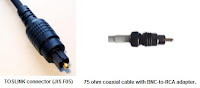
S/PDIF stands for Sony/Philips Digital Interface Format, the two companies being the primary designers of the S/PDIF format. S/PDIF is a collection of hardware and low-level protocol specifications for carrying digital audio signals between devices and stereo components. It is more recently part of a larger collection of standards IEC 60958 (often referred to as AES/EBU), where it is known as IEC 958 type II. S/PDIF is essentially a minor modification of the original AES/EBU standard for consumer use, providing small differences in the protocol and requiring less expensive hardware. A common use for the S/PDIF interface is to carry compressed digital audio as defined by the standard IEC 61937. This mode is used to connect the output of a DVD player to a home theater receiver that supports Dolby Digital or DTS surround sound.
There are no differences in the signals transmitted over optical or coaxial S/PDIF connectors—both carry exactly the same information. Selection of one over the other rests mainly on the availability of appropriate connectors on the chosen equipment and the preference and convenience of the user. Connections longer than 6 meters or so, or those requiring tight bends, should use coaxial cable, since the high light signal attenuation of TOSLINK cables limits its effective range. On the other hand, TOSLINK cables are not susceptible to ground loops and RF interference like coaxial cables. One deciding factor for many is cost—any standard 75 ohm A/V cable can be used for coaxial connectivity, while TOSLINK requires a proprietary cable which is often sold at a high mark-up.
Read more about S/PDIF here.
Labels: Knowledge
|
|
|
| posted by admin |
|
|
|
|
| ASRock ALiveNF7G-HDready |
|

This ASRock motherboard uses NVIDIA GeForce 7050 / nForce 630A MCP Chipsets and support Socket AM2 for AMD Athlon64 FX / Athlon64 X2 / Athlon X2 / Athlon64 and Sempron processors. The integrated graphic card (GeForce7 Series - NV44) supported DirectX 9.0, Pixel Shader 3.0 and Max. shared memory 256MB. For overclocking purpose this motherboard is featured by Hybrid Booster (ASRock Safe Overclocking Technology). During Overclocking, FSB enjoys better margin due to fixed PCIE/ PCI Buses. So it gives more safely for your equipment.
This computer motherboard specs are :
|
ASRock ALiveNF7G-HDready
|
|
Processor
|
- Socket AM2 for AMD Athlon 64FX / 64X2 / X2 / 64 and Sempron processors
- AMD LIVE! Ready
- Supports AMD's Cool 'n' Quiet Technology
- FSB 1000 MHz (2.0 GT/s)
- Supports Untied Overclocking Technology
- Supports Hyper-Transport Technology
|
|
Chipset
|
- NVIDIA GeForce 7050 / nForce 630A MCP
|
|
Memory
|
4 x DIMM, max. 8GB, DDR2 800 / 667 / 533 MHz, non-ECC, unbuffered memory
Dual channel memory architecture
Due to the operating system limitation, the actual memory size may be less than 4GB for the reservation for system usage under Windows® XP and Windows® Vista™. For Windows® XP 64-bit and Windows® Vista™ 64-bit with 64-bit CPU, there is no such limitation.
|
|
Graphics
|
- Integrated NVIDIA GeForce7 Series (NV44)
- DirectX9.0 VGA, Pixel Shader 3.0
- Max. shared memory 256MB
- Dual VGA Output: support DVI-D and D-Sub ports by independent display controllers
- Supports HDCP function with DVI-D port
- Supports 720p Blu-ray (BD) / HD-DVD playback
- NVIDIA PureVideo Ready
|
|
Audio
|
- 7.1 CH Windows® Vista™ Premium Level HD Audio (ALC888 Audio Codec)
- Chipset embedded HDMI Audio
|
|
LAN
|
- Gigabit LAN 10/100/1000 Mb/s
- Giga PHY Realtek RTL8211B
- Supports Wake-On-LAN
|
|
Expansion Slots
|
- 1 x PCI Express x16 slot
- 1 x PCI Express x1 slot
- 2 x PCI slots
|
|
Connector
|
- 4 x Serial ATAII 3.0 Gb/s connectors, support RAID (RAID 0, RAID 1, RAID 0+1, RAID 5, JBOD), NCQ, AHCI and "Hot Plug" functions
- 1 x ATA133 IDE connector (supports 2 x IDE devices)
- 1 x Floppy connector
- 1 x IR header
- 1 x Game header
- 1 x COM Port header
- 1 x HDMI_SPDIF header
- 1 x IEEE 1394 header
- CPU/Chassis FAN connector
- 20 pin ATX power connector
- 4 pin 12V power connector
- CD in header
- Front panel audio connector
- 4 x USB 2.0 headers (support 8 USB 2.0 ports)
|
|
Rear Panel I/O
|
- 1 x PS/2 Mouse Port
- 1 x PS/2 Keyboard Port
- 1 x VGA/D-Sub Port
- 1 x VGA/DVI-D Port
- 1 x Parallel Port (ECP/EPP Support)
- 4 x Ready-to-Use USB 2.0 Ports
- 1 x IEEE 1394 Port
- 1 x RJ-45 Port
- HD Audio Jack: Side Speaker / Rear Speaker / Central / Bass / Line in / Front Speaker / Microphone
|
|
Form Factor
|
- Micro ATX, 24.4 cm x 24.4 cm
|
Labels: AMD, ASRock
|
|
|
| posted by admin |
|
|
|
|
| FireWire (IEEE 1394) |
|

FireWire is Apple's brand name for the IEEE 1394 interface (although the 1394 standard also defines a backplane interface). It is also known as iLink (Sony’s name). FireWire system is commonly used for connection of data storage devices and DV (digital video) cameras, but is also popular in industrial systems for machine vision and professional audio systems. It is used instead of the more common USB due to its faster effective speed, higher power-distribution capabilities, and because it does not need a computer host. FireWire is also available in wireless, fibre optic and coaxial versions.
Almost all modern digital camcorders have included this connection since 1995. Many computers intended for home or professional audio/video use have built-in FireWire ports. And today, it is also widely available on retail motherboards for do-it-yourself PCs, alongside USB. FireWire was used with initial models of Apple's iPod, but later models eliminated FireWire support in favor of USB due to space constraints and for wider compatibility.

|

|
|
4-pin (left) and 6-pin (right) FireWire
|
6-pin FireWire connector
|
Labels: Knowledge
|
|
|
| posted by admin |
|
|
|
| July 21, 2007 |
| Gigabyte GA-MA69G-S3H |
|
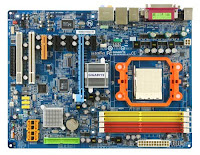
Gigabyte Technology latest S series motherboards for AMD socket AM2 platform, featuring with innovative features- Safe (such as Excellent hardware design, reinforced BIOS protection and BIOS Setting Recovery Technology), Smart (an innovative software such as Download Center, @BIOS, Q-Flash, Xpress Install, Boot menu, and Smart Fan), Speed (intelligent over-clocking and over-voltage software settings) Technologies.
The new S series motherboards GA-MA69G-S3H; supporting AMD new generation AM2 processor with dual channel DDR2 800MHz high frequency memories, providing reliable and user friendly computing and reaching the maximum system performance easily via personalized software settings. GIGABYTE S series motherboards, the champion's choice for AMD Socket AM2 platform!
|
Gigabyte GA-MA69G-S3H
|
|
Processor
|
AMD Socket AM2 Athlon64 FX / X2 Dual-Core / Athlon 64 / Sempron processors
|
|
Chipset
|
North Bridge Chipset: AMD 690G
South Bridge Chipset: ATI SB600
Super I/O chip: ITE IT8716
Integrated Peripherals :
- Realtek RTL8110 Gigabit Ethernet
- Realtek ALC889A Audio Codec
|
|
Memory
|
4 x DIMM, max. 16GB, DDR2 800 / 667 / 533 /400 MHz, non-ECC, unbuffered memory
Dual channel memory architecture
Note : Due to the limitation of Windows 32-bit operating system, when more than 4GB of physical memory is installed, the actual memory available for the operating system will be than 4GB; Windows 64-bit operating system doesn't have such limitation.
|
|
Expansion Slots
|
1 x PCI-E x16
1 x PCI-E x4
3 x PCI-E x1
2 x PCI
|
|
Back Panel I/O
|
1 x PS/2 keyboard port
1 x PS/2 mouse port
1 x D-Sub port
1 x parallel port
1 x HDMI port
1 x SPDIF Out port (optical)
1 x IEEE 1394a port
4 x USB 2.0/1.1 port
1 x RJ-45 LAN port
6 x audio jacks
|
|
H/W Monitoring
|
System voltage detection
CPU / System temperature detection
CPU / System fan speed detection
CPU / System warning temperature
CPU fan failure warning
Supports CPU Smart Fan function
|
|
Form Factor
|
ATX Form Factor, 30.5cm x 22.9cm
|
Info : Gigabyte
Labels: AMD, Gigabyte
|
|
|
| posted by admin |
|
|
|
|
| Abit IP35 Pro |
|

The chipset cooling system has been enhanced significantly: the heatsinks are of a different shape and there have 2 heat-pipe. All the capacitors on this board are solid-state now, and not only the ones in the processor voltage regulator circuitry. There is a POST-code indicator, Power On and Reset buttons. One of the PCI Express x1 slots has been replaced with a PCI Express x16 with x4 throughput capacity. The mainboard rear panel no longer caries the IEEE1394 connector – it moved to the PCB, however there is a second RJ45 network port, an SPDIF Out and two eSATA ports instead.
|
Abit IP35 Pro
|
|
Processor
|
Support Intel Core2 Extreme/Duo/Quad and Pentium Dual Core Processor
|
|
Chipset
|
Intel P35 Express / ICH9R
|
|
Front Side Bus
|
1333 / 1066 / 800 MHz
|
|
Memory
|
4 x DIMM, max. 8GB, DDR2 800 / 667, non-ECC, unbuffered memory
Dual channel memory architecture
|
|
Expansion Slots
|
1 x PCI-E x16
1 x PCI-E x16 (x4 Bandwith)
1 x PCI-E x1
3 x PCI 2.2
|
|
Internal I/O
|
1 x Floppy port
1 x ATA 133/100/66/33 IDE connector
6 x SATA 3Gb/s connector
2 x IEEE1394 (at 400Mb/s transfer rate), 3 x USB header (support 6 ports)
1 x FP-Audio
|
|
LAN
|
On board dual Gigabit LAN controllers, support 10/100/1000M Ethernet
|
|
Audio
|
On board 7.1 Ch HD Audio Codec
Support auto jack sensing and optical S/PDIF in/out
HDMI ready header (S/PDIF header)
|
|
Abit Engineered
|
Abit uGuru technology
Abit Silent OTES technology
EZ for CCMOS
|
Back Panel I/O
Ports
|
1 x PS/2 Keyboard
1 x PS/2 Mouse
Abit Silent OTES
1 x S/PDIF In, 1 x S/PDIF Out
2 x eSATA
7.1 CH Audio connector
1 x RJ45 port
4 x USB 2.0/1.1
EZ CCMOS Switch
|
|
Form Factor
|
ATX Form Factor, 30.5cm x 24.5cm
|
Info : Abit
Labels: Abit, Intel
|
|
|
| posted by admin |
|
|
|
| July 20, 2007 |
| Asus Commando |
|

Asus Commando is remarkable not only for its own unique name instead of the lettered-numeric marking. The mainboard is based on Intel 965 chipset for LGA775 processors and belongs to the new Republic of Gamers series. This mere fact implies that the board is very feature-rich and was manufactured using the latest and greatest technologies. The Republic of Gamers consists only the best of the best. This intel motherboard offer the best hardware engineering, the fastest performance, the most innovating ideas, and it welcome the best gamers to join in.
This Asus motherboard also comes with a DVD disk (not a CD disk) with the drivers, brand name utilities, a licensed version of Futuremark 3DMark06 Advanced Edition, and Kaspersky antivirus software. The funny thing is that the disk is marked with the following ”Commando motherboard – NVIDIA nForce 680i SLI Support DVD”. Asus Commando motherboard is packed into a hard transparent plastic casing that protects it against physical damage and at the same time allows enjoying a nice view of the board fragments through the cut spots in the box.
This computer motherboard specs are like in a table bellow :
|
Asus Commando
|
|
Processor
|
LGA775 socket for Intel Core 2 Extreme / Core 2 Duo /
Pentium Extreme / Pentium D / Pentium 4 / Celeron D Processors
Compatible with Intel 05B/05A/06 processors
Intel Quad-Core CPU ready
|
|
Chipset
|
Intel P965 / ICH8R
|
|
Front Side Bus
|
1066 / 800 / 533 MHz
|
|
Memory
|
4 x DIMM, max. 8GB, DDR2 800 / 667 / 533 MHz, non-ECC,
unbuffered memory
Dual channel memory architecture
|
|
Expansion Slots
|
2 x PCI-E x16 (@ x16 and x4 mode)
4 x PCI 2.2
|
|
Storage
|
Southbridge
- 6 x SATA 3.0 Gb/s ports
- Intel Matrix Storage Technology supports RAID 0, 1, 5 and 10.
PATA controller
- 1 x UltraDMA 133/100/66 for up to 2 PATA devices
|
|
LAN
|
Dual Gigabit LAN controllers, both featuring AI NET2
Marvell PCI-E and PCI Gigabit LAN controllers
|
|
Audio
|
SupremeFX Audio card featuring ADI 1988B Codec
- Support Jack-Sensing, Enumeration, Multi-streaming
and Jack-Retasking
- Coaxial / Optical S/PDIF out ports at back I/O
- Asus Noise Filter
- DTS Connect
|
|
IEEE 1394
|
2 x IEEE 1394a ports (one at midboard; one at back panel)
|
|
USB
|
10 x USB 2.0 ports (6 ports at mid-board, 4 ports at back panel)
|
Overclocking
Features
|
Extreme Tweaker
Intelligent overclocking tools:
-AI NOS (Non-delay Overclocking System)
-AI Overclocking (intelligent CPU frequency tuner)
-Asus AI Booster Utility
O.C Profile
Overclocking Protection:
-Asus C.P.R.(CPU Parameter Recall)
|
|
Asus Features
|
LCD Poster
Onboard Switches: Power / Reset / Clr CMOS
Q-Connector
Asus CrashfreeBIOS 3
Asus EZ Flash2
Asus MyLogo3
|
Back Panel I/O
Ports
|
1 x PS/2 Keyboard
1 x PS/2 Mouse
1 x S/PDIF Out (Coaxial + Optical)
1 x IEEE1394a
2 x RJ45 port
4 x USB 2.0/1.1
|
Internal I/O
Connectors
|
3 x USB connectors support additional 6 USB ports
1 x Floppy disk drive connector
1 x IDE connector
6 x SATA connectors
1 x CPU Fan connector
6 x Chassis Fan connector
1 x Power Fan connector
1 x IEEE1394a connector
1 x Azalia Digital Header
3 x thermal sensor connectors
Chassis Intrusion connector
24-pin ATX Power connector
1 x 8-pin ATX 12V Power connector
System Panel
|
|
BIOS
|
8 Mb Flash ROM, AMI BIOS, PnP, DMI2.0, WfM2.0,
SM BIOS 2.3, ACPI 2.0a, Multi-language BIOS, Asus EZ Flash 2,
Asus CrashFree BIOS 3
|
|
Manageability
|
WfM 2.0, DMI 2.0, WOL by PME, PXE
|
|
Accessories
|
UltraDMA 133/100/66 cable
FDD cable
SATA cables
SATA power cables
I/O Shield
User's manual
USB2.0 port module
3 in 1 Q-connector
7 x cable ties
IEEE1394 port module
Optional Fan for Water-Cooling or Passive-Cooling only
|
|
Support DVD
|
Drivers
Asus PC Probe II
Asus Update
AI Booster
Futuremark 3DMark06 Advanced Edition
Kaspersky Anti-Virus software (full version)
|
|
Form Factor
|
ATX Form Factor, 30.5cm x 24.5cm
|
Info : Asus
Labels: ASUS, Intel
|
|
|
| posted by admin |
|
|
|
|
| Intel® G31 Express Chipset |
|
Desktop PC platforms with the Intel G31 Express Chipset, combined with either the Intel Core2 Duo or the Intel Core2 Quad processor, deliver new technologies and innovating capabilities for consumers. The Intel G31 Express Chipset supports Intel’s upcoming 45nm processors, enabling a scalable platform for value conscious consumers. With a 1066MHz system bus, DDR2 memory technology and support for Windows Vista Premium, the Intel G31 Express chipset enables scalability and performance for everyday computing. This chipset has features like 1066/800 MHz System Bus, PCI Express 1.1 Interface, Intel Fast Memory Access, Dual-Channel DDR2 Memory Support, Intel Flex Memory Technology, Intel Graphics Media Accelerator 3100, Intel High Definition Audio, and Intel Matrix Storage.
Info : Intel
Labels: Intel
|
|
|
| posted by admin |
|
|
|
|
| Gigabyte GA-P35-DQ6 |
|

The GA-P35-DQ6 is GIGABYTE next generation, high performance platform based on the killer combination of the new Intel P35 chipset plus support for the latest multi-core processors up to FSB 1333MHz, including the upcoming 45nm platform. In addition to setting new records for blistering performance, the GA-P35-DQ6 features an all-new copper Silent Pipe thermal solution for both the chipset and CPU power MOSFET, dramatically reducing the temperature around the CPU. The GA-P35-DQ6 is also part of the GIGABYTE Ultra Durable 2 Series of motherboards, featuring top quality electronic components which provide optimized power savings, ultra cooling and extended system durability. GIGABYTE Ultra Durable 2 is consist of Ultra Cooling (using Low RDS(on) MOSFET Design), Low Power Loss (using Ferrite Core Choke Design) and Longer Life (using All-Solid Capacitor Design).
This computer motherboard specs are like in a table bellow :
|
Gigabyte GA-P35-DQ6
|
|
Processor
|
Intel Core2 Extreme Quad-Core / Core2 Duo / Intel Pentium Extreme /
Intel Pentium D processors
|
|
Chipset
|
Northbridge : Intel P35 Express Chipset
Southbridge : Intel® ICH9R
T.I IEEE 1394 Controller
Gigabit Lan Controller
8 Channels ALC889A Audio controller
|
|
Front Side Bus
|
1333 / 1066 / 800 MHz
|
|
Memory
|
4 x DIMM, max. 8GB, DDR2 1066 / 800 / 667 / 533 MHz, non-ECC,
unbuffered memory
Dual channel memory architecture
|
|
Expansion Slots
|
2 x PCI-E x16 (@ x16 and x4 mode)
3 x PCI-E x1
2 x PCI 2.2
|
Internal I/O
Connectors
|
8 Serial ATA 3Gb/s connectors
1 UDMA ATA 133/100/66/33 connector
1 FDD connector
2 IEEE 1394 connectors
4 USB 2.0/1.1 connectors (supports 8 ports)
1 audio pin header (supports 8-Channel)
1 TPM pin header
1 S/PDIF In pin header
|
|
Back Panel I/O
|
4 USB 2.0/1.1 ports
2 SPDIF Out port (coaxial+ optical)
1 IEEE 1394 port
1 LPT Port
1 COM Port
1 RJ45 port
6 audio jacks
PS/2 Keyboard/Mouse
|
|
BIOS
|
Supports Quad BIOS
2 x 8 Mbit flash ROM
Use of licensed AWARD BIOS
PnP 1.0a, DMI 2.0, SM BIOS 2.3, ACPI 1.0b
|
|
Form Factor
|
ATX Form Factor, 30.5cm x 24.5cm
|
Info : Gigabyte
Labels: Gigabyte, Intel
|
|
|
| posted by admin |
|
|
|
| July 19, 2007 |
| ECS NForce 570 SLIT-A |
|

It seems very nostalgic to say so, but back in the Pentium 4/Pentium D days, NVIDIA's nForce 4 family of chipsets proved to be the top choice, besting even Intel's own 955X/975X Express chipsets in terms of raw performance and overclockability. NVIDIA launched the successor to the nForce 4 earlier this year, but the new nForce 500 series was initially only available for the AMD platform with Intel Editions 'on the way'. Now with all the attention around Intel's new babies - the Core 2 processor and Broadwater chipset - it has been a while since we've seen NVIDIA's chipsets in the limelight. So comes into play ECS' new NFORCE 570 SLIT-A (rev 5.1) motherboard. As its name implies, it is based on the nForce 570 SLI Intel Edition chipset.
This computer motherboard specs are :
- Processor : Intel Socket LGA775
- Chipset : NVIDIA nForce 570 SLI
- Memory slots : 4 x DDR2 max 4GB
- Form factor : ATX
- AGP/PCI/PCIe x16/PCIe x4/PCIe x1 : 0/3/2/0/2
- USB/FireWire/Serial/Paralel : 4(6)/0/1/1
- Audio : Realtek ALC883 8-channel HD Audio codec
- NIC : NVIDIA Gigabit LAN co-supported by Marvell 88E1116 PHY chip (Transceiver)
Info : ECS
Labels: ECS, Intel
|
|
|
| posted by admin |
|
|
|
|
| MSI P6N SLI Platinum |
|

MSI has been a major player in the motherboard market for several years now. The P6N-SLI Platinum is built around the 650i SLI chipset. The 650i SLI chipset is the entry level SLI compatible offering in NVIDIA’s 600 series MCPs. Fortunately it offers most of the performance features of its more expensive siblings. The MSI P6N-SLI Platinum supports the latest Intel Core2 Extreme Quad-Core / Core2 Duo / Intel Pentium Extreme and Intel Pentium D processors. Following industry trends the P6N-SLI Platinum requires only a few components to create a working machine. The required components are: Socket LGA775 CPU, DDR 2 memory, power supply, drives and a video card. MSI integrated the following components into the 650i Ultra’s design: 1 ATA-133 port; 1 floppy port; 8 USB ports; (4 on the backplane and 2 headers supporting 2 ports each.) ; 4 SATA 3G ports; 1 eSATA port; 2 IEEE1394 ports (1 on the backplane and 1 header supporting 1 port each.); 1 GigE Ethernet port; 6 mini-headphone jacks and of course standard PS/2 keyboard and mouse ports.
This computer motherboard specs are :
- Processor : Intel Socket LGA775
- Chipset : NVidia nForce 650i SLI
- Memory slots : 4 x DDR2 max 8GB
- Form factor : ATX
- AGP/PCI/PCIe x16/PCIe x4/PCIe x1 : 0/3/2/0/1
- USB/FireWire/Serial/eSATA : 4(4)/1/1/1
- Audio : Realtek ALC888 HD audio codec
- NIC : Realtek GigE Ethernet port
Info : MSI
Labels: Intel, MSI
|
|
|
| posted by admin |
|
|
|
| July 18, 2007 |
| Biostar TForce P965 Deluxe |
|

Intel's Core 2 Duo takes a whole new architecture, throws in a smattering of impressive sounding tweaks, twists and optimizations then packages it all in a 65nm, dual core, Quad Pumped 1066MHz package. The P965 chipset has proven itself time and time again as an overclocker’s dream chipset allowing Core 2 Duo overclocks well into the 3GHz+ rang using the slowest Core 2 Duo processor, the E6300.
This computer motherboard does not support dual video card configurations such as ATI’s Crossfire, or NVIDIA’s SLI technologies. Memory speeds of up to DDR 800 are officially supported using DDR 2 memory modules. Following industry trends, the TForce P965 requires few components to operate as a full system. Components needed include an LGA 775 processor, ATX 2.0 power supply, hard drive, DDR 2 memory, and a video card. Biostar chose to integrate the following components into the TForce P965; 1 EIDE ATA-133 port; 1 floppy port; 6 SATA 3G ports on the ICH8R south bridge; 10x USB 2.0 compatible ports (6 on the rear panel, and 2 onboard headers supporting 2 ports each); 1 Gigabit Ethernet port on the rear panel; Realtek ALC883 8+2 Channel HD Audio Codec with SPDIF out ports on the back IO panel and as always, the standard PS/2 keyboard and mouse ports.
This computer motherboard specs are :
- Processor : Intel Socket 775, FSB 1066MHz
- Chipset : Intel P965 + ICH8R
- Memory slots : 4
- Form factor : ATX
- AGP/PCI/PCIe x16/PCIe x4/PCIe x1 : 0/3/1/1/1
- Audio : Realtek ALC883 8+2 Channel HD Audio Codec
- USB/FireWire/Serial/Paralel : 6(4)/0/0/0
Info : Biostar
Labels: Biostar, Intel
|
|
|
| posted by admin |
|
|
|
|
| Asus Crosshair |
|

Since AMD made the move to an on-chip memory controller with the Athlon 64 processor, the AMD motherboard market has been fairly stagnant as motherboard and chipset designers struggled to find a way to make their products better than the competition, without the crutch of memory controller performance to lean on. Based on the NVIDIA nForce 590 SLI chipset, this computer motherboard has some unique features on it, like LCD post display, audio riser card and liquid cooled chipsets were the main attractions.
This computer motherboard specs are :
- Processor : AMD Socket AM2 (Athlon64 X2 / Athlon64 FX / Athlon64/ Sempron)
- Chipset : NVIDIA nForce 590 SLI MCP
- Memory slots : 4 x DIMM, max. 8GB, DDR2-800/667/533
- Form factor : ATX
- AGP/PCI/PCIe x16/PCIe x4/PCIe x1 : 0/3/2/1/0
- USB/FireWire/Serial/Paralel/RJ-45 : 4(3)/1(1)/0/0/2
Info : Asus
Labels: AMD, ASUS
|
|
|
| posted by admin |
|
|
|
| July 17, 2007 |
| Asus M2V-X |
|

The M2V-X provides an environment for superior performance in CPU, memory and system bus, while incorporating rich features such as EZ Flash 2 and CrashFreeBIOS 3. EZ Flash 2 is a user-friendly BIOS update utility. Simply launch this tool and update BIOS from a USB flash disk before entering the OS. You can update your BIOS only in a few clicks without preparing an additional floppy diskette or using an OS-based flash utility. An the ASUS CrashFree BIOS 3 allows users to restore corrupted BIOS data from a USB flash disk containing the BIOS file. This utility saves users the cost and hassle of buying a replacement BIOS chip.
The M2V-X is a great merge of the latest AMD AM2 processor with the 64 architecture and VIA's K8T890 chipset to juice up your life. Using AM2 socket ensure this computer motherboard fully support single-core Athlon 64/ Sempron and dual-core Athlon 64 X2/ Athlon 64 FX processors with 2MB / 1MB / 512KB L2 cache, which is based on 64-bit architecture. It features 2000 / 1600 MT/s HyperTransport Bus, dual-channel un-buffered DDR2 800 memory support and AMD Cool ´n´ Quiet! Technology.
This computer motherboard specs are :
- Processor : AMD Socket AM2 (Athlon64 X2 / Athlon64 FX / Athlon64 / Sempron)
- Chipset : VIA K8T890/VT8237A
- Memory slots : 4
- Form factor : ATX
- AGP/PCI/PCIe x16/PCIe x4/PCIe x1 : 0/4/1/0/1
- USB/FireWire/Serial/Paralel : 4(4)/0/0/1
Info : Asus
Labels: AMD, ASUS
|
|
|
| posted by admin |
|
|
|
|
| Abit AN-M2HD |
|

This motherboard is designed for AMD® Socket AM2 Processors with 2000M T/s system bus using Hyper Transport Technology. With NVIDIA GeForce 7050PV/nForce 630a chipset, it provides full NVIDIA nView multi-display technology capability, with independent display controllers for one digital HDTV and one analog monitor. The graphic card that be integrated has shader model 3.0 so its fully compatible with directx 9 and programmable pureVideo HD video processor.
The interesting feature from this motherboard is HDMI with integrated HDCP key. The High-Definition Multimedia Interface (HDMI) delivers pure and uncompressed digital video. Watch videos and TV in high definition. It has never been brighter and more vivid. High definition gaming offers the most enthralling and discerning moments in entertainment. The integrated on-chip HDCP key for protected content on Blu-Ray and HD-DVDs makes sure that you can always enjoy the full quality of your movies.
This computer motherboard specs are :
- Processor : AMD Socket AM2 (Athlon64 X2 / Athlon64 FX / Athlon64 / Sempron)
- Chipset : Nvidia Geforce7050PV/nForce 630a
- Memory slots : 4
- Form factor : mATX
- AGP/PCI/PCIe x16/PCIe x4/PCIe x1 : 0/2/1/0/1
- USB/FireWire/Serial/Paralel : 4(4)/0/1(1)/0
Info : Abit
Labels: Abit, AMD
|
|
|
| posted by admin |
|
|
|
| July 16, 2007 |
| DFI LANParty UT ICFX3200-T2R |
|

It has been over a year since ATI announced CrossFire for Intel. While the RD480 for AMD was launched amidst a lot of fanfare and was soon followed up with the impressive RD580/SB600 combination for AMD, the ATI Intel chipset design lagged in both development and performance.
ATI introduced the Radeon Xpress 200 CrossFire for Intel (RD400) in September of 2005 and its successor known as the RD600 is being officially released now. By release of the LANParty UT ICFX3200-T2R/G, DFI becomes the first and perhaps only motherboard manufacturer to release product based upon this unique chipset. The RD600 itself (officially called ICFX3200), include independent memory and FSB overclocking capabilities, 1066MHz front side bus support, 1066MHz+ DDR2 memory support, automatic PCIe overclocking, and full support for the entire Core 2 Duo processor lineup. For this motherboard, DFI pairs the RD600 up with the SB600 Southbridge that features four SATA-2 3Gb/s ports featuring NCQ and hot plug support, ten USB 2.0 ports, HD audio interface, and multiple Gigabit Ethernet support depending upon the Northbridge utilized.
The PCI Express and PCI slot arrangements are designed with multiple graphics card operation in mind but this layout will mean the removal of your primary graphics card if you need to switch memory. The board includes six fan headers, three of which can be controlled in the BIOS or by the included ITE Guardian utility. Other nice touches include the onboard power and reset buttons along with a diagnostic LED display. You can clear the CMOS by using the jumper or by simultaneously holding down the reset and power buttons for four seconds. If the board is in a case this same procedure can be completed by holding down the front panel reset and power buttons. DFI also includes the new AMD System Manager that allows you to change voltages, memory, and FSB values within Windows.
This computer motherboard specs are :
- Processor : LGA775-based (Pentium 4, Celeron D, Pentium D, Pentium EE, Core 2 Duo, Core 2 Extreme)
- Chipset : AMD RD600 + SB600
- Memory slots : 4
- Form factor : ATX
- AGP/PCI/PCIe x16/PCIe x4/PCIe x1 : 0/3/3/0/0
- USB/FireWire/Serial/Paralel : 6(4)/1(1)/1/0
Info : DFI
Labels: DFI, Intel
|
|
|
| posted by admin |
|
|
|
|
| Gigabyte GA-P35-DS3R |
|

As this motherboard specs, the GA-P35-DS3R is a Gigabyte high performance platform based on the killer combination of the new Intel P35 chipset plus support for the latest multi-core processors up to FSB 1333MHz, including the upcoming 45nm platform. The GA-P35-DS3R is also part of the Gigabyte Ultra Durable 2 Series of motherboards, featuring top quality electronic components which provide optimized power savings, ultra cooling and extended system durability.
Like another P35 chipset motherboard, Gigabyte GA-P35-DS3R is provided the advanced technology of DDR2 1066 memory, featuring faster speeds and higher data bandwidth, which delivers superior performance for the most demanding applications. As a member of the global community to look after the environment, Gigabyte complies with the European Union's Restriction of use of certain Hazardous Substances (RoHS) directive which limits the use of lead, mercury, cadmium and other hazardous substances in electronic products. From components and material selection to production, Gigabyte has carefully examined and designed this product to be 100% RoHS compliant.
This computer motherboard specs are :
- Processor : LGA775-based (Pentium 4, Celeron D, Pentium D, Pentium EE, Core 2 Duo, Core 2 Extreme)
- Chipset : Intel P35
- Memory slots : 4
- Form factor : ATX
- AGP/PCI/PCIe x16/PCIe x4/PCIe x1 : 0/3/1/0/0
- USB/FireWire/Serial/Paralel : 4(8)/0/1/1
Info : Gigabyte
Labels: Gigabyte, Intel
|
|
|
| posted by admin |
|
|
|
|
| Search another Motherboard |
|
|
| Previous Post |
|
| Subscribe for daily update |
|
|
| Archives |
|
|
| Template by |

|
|


.jpg)


